Explore All Exams at KGS


All Exams
Explore All Exams at KGS

Khan Sir Courses
Geography I Polity I History | World Map I Indian Map I Economics I Biology

UPSC & State PSC
UPSC I BPSC I UP-PSC I MP-PSC

State Exams
UP I Bihar I MP | Rajasthan

NEET | JEE | CUET
NEET | JEE | CUET

Defence Exams
NDA I CDS I CAPF I AFCAT I SSB I Agniveer

Police Exams
UP SI | Bihar SI | Delhi Police | UP Constable

SSC Exams
CGL I CPO I CHSL I MTS I SSC GD I Delhi Police

Foundation Courses
Physics I Chemistry I Biology I History I Geography I Polity I NCERT I Math I English | Map I Reasoning

Railway Exams
RRB | RPF

Teaching Exams
TET | Teaching | UGC

Banking Exams
SBI | RBI | IBPS

Engineering Exams
Civil | Electrical | Mechanical
UGC NET
UGC NET/JRF
Current Affairs provides you with the best compilation of the Daily Current Affairs taking place across the globe: National, International, Sports, Science and Technology, Banking, Economy, Agreement, Appointments, Ranks, and Report and General Studies

Current Affairs
SYLLABUS
GS-2: Bilateral, regional and global groupings and agreements involving India and/or affecting India’s interests.
Context: Recently, the President of South Korea paid a State Visit to India from April 19–21, 2026, resulting in the adoption of a Joint Strategic Vision (2026–2030) to strengthen the India–ROK Special Strategic Partnership.
More on the News
• The visit aimed to strengthen the Special Strategic Partnership between the two countries across multiple sectors.
• Discussions focused on key areas such as trade, investments, shipbuilding, semiconductors, artificial intelligence, and emerging technologies.
• Both countries also exchanged views on regional and global issues, particularly in the Indo-Pacific region, highlighting their shared vision for peace and stability.
• The visit reflects the growing importance of India–South Korea relations in the context of global economic shifts and geopolitical tensions.
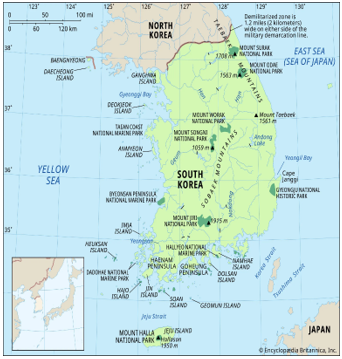
Key Outcomes of the Visit
• Strategic & Institutional Outcomes: Adoption of a Joint Strategic Vision to transform ties into a “futuristic partnership.”
• Economic & Trade Outcomes: Bilateral trade is currently at $27 billion, with a target to reach $50 billion by 2030.
• Technology & Industrial Cooperation: Launch of the India-Korea Digital Bridge for collaboration in Artificial Intelligence, semiconductors, and digital innovation ecosystems.
• Energy, Climate & Sustainability: Joint Statements on energy resource security and sustainability cooperation.
• Cultural & People-to-People Initiatives: Announcement of India-ROK Friendship Year (2028–29).
• Financial & Institutional Agreements: MoU between IFSCA and Korean financial regulators and NPCI International Payments Ltd. and Korean clearing systems.
India–Republic of Korea (ROK) Bilateral Relations
|
Historical Relations: |
·
India and the ROK
established consular relations in 1962 and diplomatic ties in 1973,
later upgraded to a Special Strategic Partnership in 2015. ·
Leadership
interactions continued through G20, G7, and East Asia Summit platforms
(2023–2025). ·
India
contributed significantly during the Korean War through UN mediation,
medical aid, and prisoner repatriation efforts. ·
Cultural
connections were reinforced by Rabindranath Tagore’s poem Lamp of the
East. |
|
Economic Relations: |
·
The CEPA (2010)
boosted trade to about USD 26.9 billion in 2024–25, though with
a trade deficit for India. ·
India
exports petroleum products,
metals, and steel, while importing electronics, machinery, and
automobile components. ·
ROK is the 13th
largest FDI investor in India with a strong presence in
manufacturing, electronics, and automobiles. |
|
Defence Relations: |
·
Defence ties
are guided by key MoUs: 2005 (Defence Industry & Logistics), 2010
(Defence R&D), and 2020 (Defence Industry Roadmap). ·
Maritime
cooperation is a major pillar, including the first bilateral naval
exercise (2025) and Coast Guard MoU on Maritime Search and
Rescue. ·
Participation
in defence exhibitions like KADEX and dialogues such as Seoul
Defence Dialogue and Delhi Defence Dialogue strengthens strategic and
technological cooperation. |
|
Diaspora: |
·
The Indian
community in ROK is around 18,000, comprising students,
professionals, and researchers. ·
A large number
of Indians are engaged in STEM education and high-skilled sectors like IT and
automobiles. ·
Indian diaspora
associations actively promote cultural engagement and community welfare. |
Khan Global Studies App
With our training programs, learning online can be a very exciting experience. Take the next step toward achieving your professional and personal objectives.


Course Related Query:
Ask Your DoubtsStore Related Query:store@khanglobalstudies.comNCERT Books
Resources
We love learning. Through our innovative solutions, we encourage ourselves, our teams, and our Students to grow. We welcome and look for diverse perspectives and opinions because they enhance our decisions. We strive to understand the big picture and how we contribute to the company’s objectives. We approach challenges with optimism and harness the power of teamwork to accomplish our goals. These aren’t just pretty words to post on the office wall. This is who we are. It’s how we work. And it’s how we approach every interaction with each other and our Students.
Come with an open mind, hungry to learn, and you’ll experience unmatched personal and professional growth, a world of different backgrounds and perspectives, and the freedom to be you—every day. We strive to build and sustain diverse teams and foster a culture of belonging. Creating an inclusive environment where every students feels welcome, appreciated, and heard gives us something to feel (really) good about.