You're all caught up—no notifications available.
Explore All Exams at KGS


All Exams
Explore All Exams at KGS

Khan Sir Courses
Geography I Polity I History | World Map I Indian Map I Economics I Biology

UPSC & State PSC
UPSC I BPSC I UP-PSC I MP-PSC

State Exams
UP I Bihar I MP | Rajasthan

NEET | JEE | CUET
NEET | JEE | CUET

Defence Exams
NDA I CDS I CAPF I AFCAT I SSB I Agniveer

Police Exams
UP SI | Bihar SI | Delhi Police | UP Constable

SSC Exams
CGL I CPO I CHSL I MTS I SSC GD I Delhi Police

Foundation Courses
Physics I Chemistry I Biology I History I Geography I Polity I NCERT I Math I English | Map I Reasoning

Railway Exams
RRB | RPF

Teaching Exams
TET | Teaching | UGC

Banking Exams
SBI | RBI | IBPS

Engineering Exams
Civil | Electrical | Mechanical
UGC NET
UGC NET/JRF
Current Affairs provides you with the best compilation of the Daily Current Affairs taking place across the globe: National, International, Sports, Science and Technology, Banking, Economy, Agreement, Appointments, Ranks, and Report and General Studies

SYLLABUS
GS-3: Awareness in the fields of Space.
Context: Recently, NASA has successfully launched the Artemis II mission, marking the first crewed journey to the vicinity of the Moon since Apollo 17 in 1972.
More on the News
• The mission was launched on April 1, 2026, from the Kennedy Space Center using the Space Launch System (SLS) rocket, carrying four astronauts aboard the Orion spacecraft.
• The crew remains in Earth orbit for about a day to:
• After system validation, the spacecraft performs the Trans-Lunar Injection (TLI) burn, sending it toward the Moon.
• The spacecraft follows a free-return trajectory, travelling around the Moon at a distance of about 7,500–10,000 km, including views of the far side, before returning to Earth.
• The mission duration is approximately 10 days, ending with re-entry at around 40,000 km/h and splashdown in the Pacific Ocean.
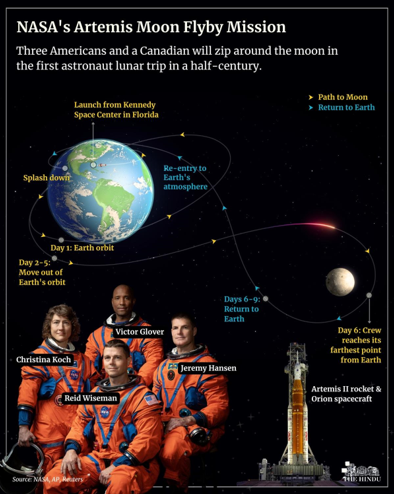
About the Artemis II Mission
• Artemis II is the first crewed mission of NASA’s Artemis programme, marking humanity’s return to deep space beyond low Earth orbit for the first time since Apollo 17.
• It is designed as a test flight without a lunar landing to validate systems required for future missions.
• The mission uses NASA’s powerful Space Launch System (SLS) rocket to launch the crew aboard the Orion spacecraft, which is specifically designed to support human life and operations during deep-space missions.
• Objectives: The primary objective of Artemis II is to test life-support systems with astronauts onboard, while also validating the spacecraft’s navigation, communication, and safety systems, thereby ensuring that all critical technologies and operations are ready for future crewed lunar landing missions.
• Crew Composition: The mission carries a four-member crew consisting of commander Reid Wiseman, pilot Victor Glover, and mission specialists Christina Koch and Jeremy Hansen.
• Scientific & Technical Aspects: The mission includes deployment of CubeSats and scientific observations.
• Significance:
About the Artemis I Mission
• Launched in 2022, Artemis I was the first mission of NASA’s Artemis programme and marked the beginning of a series of increasingly complex missions aimed at enabling human exploration of the Moon and eventually Mars.
• It was an uncrewed lunar flight test conducted from November 16 to December 11, 2022, lasting 25 days, during which the Space Launch System (SLS) carried the Orion spacecraft on a 1.4-million-mile journey beyond the Moon and back.
• The mission was designed to test critical deep-space exploration systems and successfully demonstrated key capabilities of Orion, including lunar flybys, operation in a distant retrograde orbit, and safe atmospheric re-entry followed by splashdown in the Pacific Ocean.
• Artemis I also set a new benchmark in human-rated deep space exploration, as the spacecraft reached a maximum distance of 268,563 miles from Earth, surpassing the previous record set during Apollo 13, thereby paving the way for future crewed missions.
The most trusted learning platform on your phone
With our training programs, learning online can be a very exciting experience! Take the next step toward achieving your professional and personal objectives



Course Related Query:
Ask Your DoubtsStore Related Query:store@khanglobalstudies.comNCERT Books
Resources
We love learning. Through our innovative solutions, we encourage ourselves, our teams, and our Students to grow. We welcome and look for diverse perspectives and opinions because they enhance our decisions. We strive to understand the big picture and how we contribute to the company’s objectives. We approach challenges with optimism and harness the power of teamwork to accomplish our goals. These aren’t just pretty words to post on the office wall. This is who we are. It’s how we work. And it’s how we approach every interaction with each other and our Students.
Come with an open mind, hungry to learn, and you’ll experience unmatched personal and professional growth, a world of different backgrounds and perspectives, and the freedom to be you—every day. We strive to build and sustain diverse teams and foster a culture of belonging. Creating an inclusive environment where every students feels welcome, appreciated, and heard gives us something to feel (really) good about.
Get Free academic Counseling & Course Details