You're all caught up—no notifications available.
Explore All Exams at KGS


All Exams
Explore All Exams at KGS

Khan Sir Courses
Geography I Polity I History | World Map I Indian Map I Economics I Biology

UPSC & State PSC
UPSC I BPSC I UP-PSC I MP-PSC

State Exams
UP I Bihar I MP | Rajasthan

NEET | JEE | CUET
NEET | JEE | CUET

Defence Exams
NDA I CDS I CAPF I AFCAT I SSB I Agniveer

Police Exams
UP SI | Bihar SI | Delhi Police | UP Constable

SSC Exams
CGL I CPO I CHSL I MTS I SSC GD I Delhi Police

Foundation Courses
Physics I Chemistry I Biology I History I Geography I Polity I NCERT I Math I English | Map I Reasoning

Railway Exams
RRB | RPF

Teaching Exams
TET | Teaching | UGC

Banking Exams
SBI | RBI | IBPS

Engineering Exams
Civil | Electrical | Mechanical
UGC NET
UGC NET/JRF
Current Affairs provides you with the best compilation of the Daily Current Affairs taking place across the globe: National, International, Sports, Science and Technology, Banking, Economy, Agreement, Appointments, Ranks, and Report and General Studies

SYLLABUS
GS-3: Major crops cropping patterns in various parts of the country, different types of irrigation and irrigation systems storage, transport and marketing of agricultural produce and issues and related constraints; e-technology in the aid of farmers.
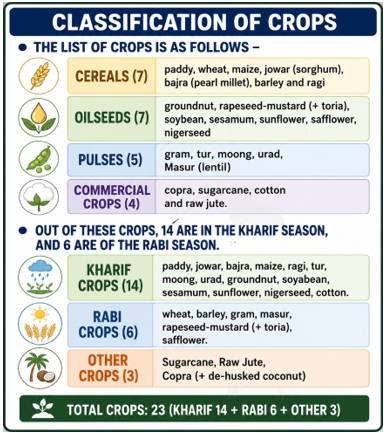
Context: The Cabinet Committee on Economic Affairs (CCEA), chaired by Prime Minister Narendra Modi, approved an increase in the Minimum Support Prices (MSP) for 14 Kharif crops for the Marketing Season (MS) 2026-27.
More on the News
• MSPs for Kharif crops were increased to ensure remunerative prices to farmers and maintain MSP at least 1.5 times the all-India weighted average cost of production, in line with the Union Budget 2018-19 announcement.
• The highest absolute increase in MSP was announced for sunflower seed (₹622 per quintal), followed by cotton (₹557), nigerseed (₹515), and sesamum (₹500).
• The expected margin over cost of production is highest for moong (61%), followed by bajra and maize (56%) and tur/arhar (54%), while the remaining crops are estimated to provide a 50% margin.
• The government stated that higher MSPs for pulses, oilseeds, and nutri-cereals (Shree Anna) are aimed at promoting crop diversification and reducing dependence on cereals.
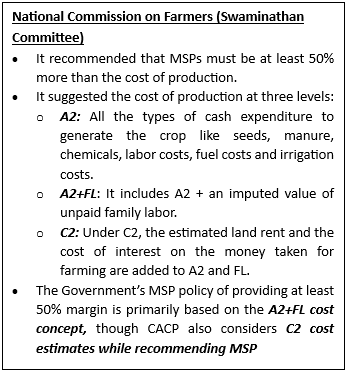
Minimum Support Price (MSP)
• The MSP is a form of market intervention by the Government to protect agricultural producers against any sharp fall in farm prices.
• MSPs are announced by the Cabinet Committee on Economic Affairs (CCEA) at the beginning of the sowing season for certain crops based on the recommendations of the Commission for Agricultural Costs and Prices (CACP).
• The major objectives of MSP are:
• In formulating the recommendations for minimum support prices, the CACP takes into account various factors such as –
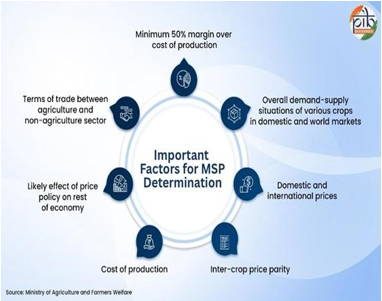
• Currently, the government announces minimum support prices (MSPs) for 22 Mandated Crops and FRP (fair and remunerative price) for sugarcane.
About Commission for Agricultural Costs & Prices (CACP)
• CACP is an attached office of the Ministry of Agriculture and Farmers Welfare, Government of India.
• It came into existence in January 1965 as the Agricultural Prices Commission. It was later renamed as CACP in 1985.
• Currently, the Commission comprises a Chairman, a Member Secretary, one Member (Official), and two Members (Non-Official).
About the Pricing Policy for Sugarcane
• Sugarcane pricing is governed under the Sugarcane (Control) Order, 1966, issued under the Essential Commodities Act.
• Before 2009-10, the government fixed the Statutory Minimum Price (SMP) for sugarcane.
• In 2009, SMP was replaced with the Fair and Remunerative Price (FRP) system after amendments to the Sugarcane (Control) Order.
• FRP includes “reasonable margins for growers on account of risk and profits” as a statutory factor.
• Factors Considered While Fixing FRP: The Commission for Agricultural Costs and Prices considers:
The most trusted learning platform on your phone
With our training programs, learning online can be a very exciting experience! Take the next step toward achieving your professional and personal objectives



Course Related Query:
Ask Your DoubtsStore Related Query:store@khanglobalstudies.comNCERT Books
Resources
We love learning. Through our innovative solutions, we encourage ourselves, our teams, and our Students to grow. We welcome and look for diverse perspectives and opinions because they enhance our decisions. We strive to understand the big picture and how we contribute to the company’s objectives. We approach challenges with optimism and harness the power of teamwork to accomplish our goals. These aren’t just pretty words to post on the office wall. This is who we are. It’s how we work. And it’s how we approach every interaction with each other and our Students.
Come with an open mind, hungry to learn, and you’ll experience unmatched personal and professional growth, a world of different backgrounds and perspectives, and the freedom to be you—every day. We strive to build and sustain diverse teams and foster a culture of belonging. Creating an inclusive environment where every students feels welcome, appreciated, and heard gives us something to feel (really) good about.