Explore All Exams at KGS


All Exams
Explore All Exams at KGS

Khan Sir Courses
Geography I Polity I History | World Map I Indian Map I Economics I Biology

UPSC & State PSC
UPSC I BPSC I UP-PSC I MP-PSC

State Exams
UP I Bihar I MP | Rajasthan

NEET | JEE | CUET
NEET | JEE | CUET

Defence Exams
NDA I CDS I CAPF I AFCAT I SSB I Agniveer

Police Exams
UP SI | Bihar SI | Delhi Police | UP Constable

SSC Exams
CGL I CPO I CHSL I MTS I SSC GD I Delhi Police

Foundation Courses
Physics I Chemistry I Biology I History I Geography I Polity I NCERT I Math I English | Map I Reasoning

Railway Exams
RRB | RPF

Teaching Exams
TET | Teaching | UGC

Banking Exams
SBI | RBI | IBPS

Engineering Exams
Civil | Electrical | Mechanical
UGC NET
UGC NET/JRF
News Highlights provides you with the best compilation of the Daily News Highlights taking place across the globe: National, International, Sports, Science and Technology, Banking, Economy, Agreement, Appointments, Ranks, and Report and General Studies

1.
India's April retail inflation, at a 13-month high of 3.48%, is only marginally higher than its March print of 3.4%, and continues to remain deceptively benign. Wholesale inflation has more than doubled to 8.3% in April from 3.88% in March - a 42-month high - signalling that substantial upstream price pressures are still working their way through the economy.
2.
Despite the defence, commerce and trade deals, India needs to be aware of a possible European alignment with the United States
3.
India has made remarkable strides in health care over the past four decades. It has built institutions of global repute, trained exceptional clinicians, and expanded access to advanced treatments. Yet, even as it celebrates these achievements, it must confront a deeper truth: it has built a system that responds to illness far more effectively than it preserves health.
4.
The outbreak of hostilities in the Persian Gulf and the closure of the Strait of Hormuz have created profound uncertainty in global markets, leading to capital outflows from emerging market economies such as India.
Foreign investors may have already priced in the possibility of future interest rate increases abroad, while the war merely accelerated the depreciatory pressures that the rupee had already been facing for some time.
5.
The recently released Periodic Labour Force Survey (PLFS) 2025 report offers some key insights.
It points to measurable progress across several dimensions, while also underlining some challenges that must be addressed to fully leverage India's demographic dividend.
The Labour Force Participation Rate stands at 59%, the Workforce Participation Rate at 57%, and the unemployment rate at 3%. These are robust headline indicators. Youth unemployment has declined since 2024, with gains for rural and urban youth. Monthly PLFS bulletins through 2025 also point to improving trends in women's participation.
6.
The Election Commission of India (EC) on Thursday announced the schedule for Phase 3 of the special intensive revision (SIR) of electoral rolls in 16 States and three Union Territories beginning May 30.
7.
Highlighting India's traditional approach to the Israel-Palestinian conflict, External Affairs Minister S. Jaishankar on Thursday presented the "National Statement" at the BRICS ministerial, reiterating India's call for a "two-state solution" to the issue and calling for an end to "risks to maritime traffic, and disruptions to energy infrastructure" in the Gulf region.
8.
The Supreme Court on Thursday nudged the Union government to address concerns over its dominant role in the appointment of Chief Election Commissioners and Election Commissioners, observing that free and fair elections depend on a truly Election independent Commission.
9.
The World Health Organization (WHO) has said the COVID-19 pandemic ex-posed vulnerabilities in global health systems and was linked to an estimated 22.1 million excess deaths, including indirect deaths, between 2020 and 2023.
The estimate, published in the WHO's flagship World Health Statistics re-port, is more than three times the number of officially reported COVID-19 deaths and reflects the scale of the pandemic's global impact.
10.
In the first sign of the impact of the West Asia crisis on prices in India, wholesale inflation in India jumped to 8.3% in April 2026, its highest level in 3.5 years, driven by the sharp rise in crude oil and natural gas prices. Inflation in this category stood at 67.2% in April.
11.
In a major boost for India's seafood industry, the country has been re-included in the list of nations that can export aquaculture products to the EU from September 2026, as it has proven its compliance with EU restrictions related to use of antimicrobials in animals used for food.
12.
The Department of Commerce issued a notification on Wednesday moving sugar from 'restricted' to 'prohibited' list of items for exports. Export of raw, white and refined sugar is banned till September 30, 2026. The ban, however, does not apply to exports to the United States and the European Union under the CXL and TRQ quota, and ex-ports under the advance authorisation scheme.
13.
Lebanon and Israel held new peace talks in Washington on Thursday, as their latest cease-fire considered to still be in place despite hundreds of deaths in Israeli strikes nears its end.
Israel's military said it was striking Hezbollah targets in south Lebanon on Thursday after warning residents of several towns and villages there and in the country's east to evacuate.
14.
A couple of days ago on a hot May day, a niche group of people across the world celebrated. The reason the endocrinologists were rejoicing was the change in the nomenclature of a single condition, only one letter had changed, and it seemed as if the festivities were a bit disproportionate. The Endocrine Society, a global network of people dealing with hormones, announced that PCOS (Polycystic Ovarian Syndrome) would henceforth be known as PMOS (Polyendocrine Metabolic Ovarian Syndrome).
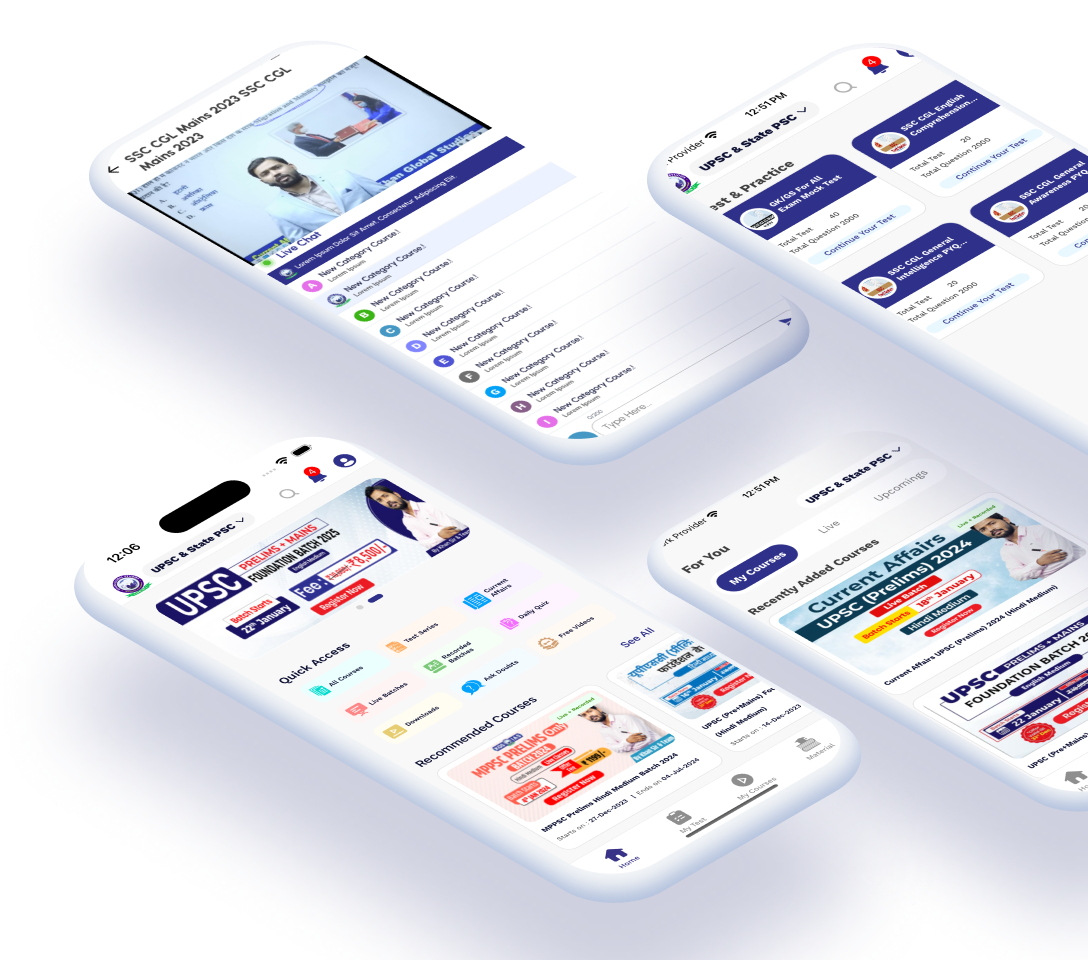
Khan Global Studies App
With our training programs, learning online can be a very exciting experience. Take the next step toward achieving your professional and personal objectives.


Course Related Query:
Ask Your DoubtsStore Related Query:store@khanglobalstudies.comNCERT Books
Resources
We love learning. Through our innovative solutions, we encourage ourselves, our teams, and our Students to grow. We welcome and look for diverse perspectives and opinions because they enhance our decisions. We strive to understand the big picture and how we contribute to the company’s objectives. We approach challenges with optimism and harness the power of teamwork to accomplish our goals. These aren’t just pretty words to post on the office wall. This is who we are. It’s how we work. And it’s how we approach every interaction with each other and our Students.
Come with an open mind, hungry to learn, and you’ll experience unmatched personal and professional growth, a world of different backgrounds and perspectives, and the freedom to be you—every day. We strive to build and sustain diverse teams and foster a culture of belonging. Creating an inclusive environment where every students feels welcome, appreciated, and heard gives us something to feel (really) good about.